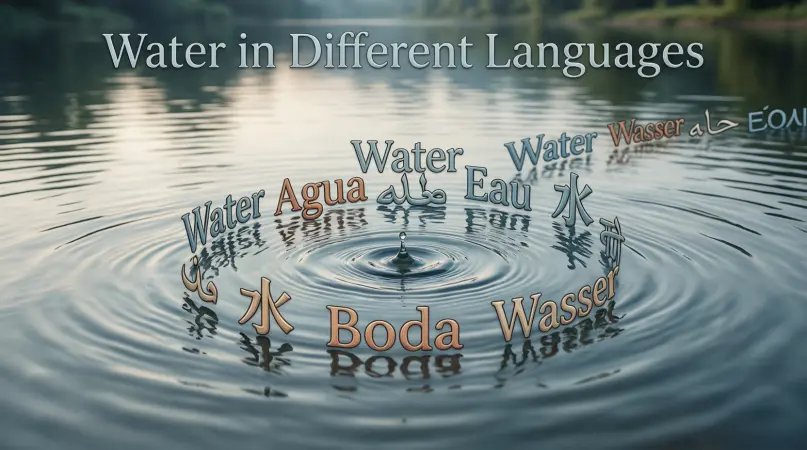
The phrase “water in different languages” refers to how people around the world say the word water, one of the most important words for daily life. Water is essential for drinking, cooking, cleaning, and survival.
People search for water in different languages to learn new vocabulary, travel, study languages, or create multilingual content.
In this guide, you will learn how to say water in 75 countries, including pronunciation, uses, and simple example sentences for easy understanding.
How to Say “Water” in 75 Different Languages
United States
Word: Water
Pronunciation: waw-ter
Uses: Used for drinking water.
Example:
I need water.
Drink more water.
United Kingdom
Word: Water
Pronunciation: waw-tuh
Uses: Daily usage word.
Example:
Please give water.
Water is cold.
Canada
Word: Water
Pronunciation: waw-ter
Uses: Common daily term.
Example:
Bring water please.
Water is fresh.
Mexico
Word: Agua
Pronunciation: ah-gwah
Uses: Spanish word for water.
Example:
Quiero agua.
El agua está fría.
Brazil
Word: Água
Pronunciation: ah-gwa
Uses: Portuguese term.
Example:
Preciso de água.
Água está fria.
Argentina
Word: Agua
Pronunciation: ah-gwah
Uses: Spanish usage.
Example:
Dame agua.
El agua es fría.
France
Word: Eau
Pronunciation: oh
Uses: French word for water.
Example:
Je veux de l’eau.
L’eau est froide.
Germany
Word: Wasser
Pronunciation: vah-ser
Uses: German word.
Example:
Ich brauche Wasser.
Das Wasser ist kalt.
Spain
Word: Agua
Pronunciation: ah-gwah
Uses: Common Spanish usage.
Example:
Dame agua.
Agua fría por favor.
Italy
Word: Acqua
Pronunciation: ahk-kwah
Uses: Italian word for water.
Example:
Voglio acqua.
L’acqua è fredda.
Portugal
Word: Água
Pronunciation: ah-gwa
Uses: Portuguese usage.
Example:
Quero água.
Água está fria.
Netherlands
Word: Water
Pronunciation: vah-ter
Uses: Dutch term.
Example:
Ik wil water.
Water is koud.
Belgium
Word: Eau
Pronunciation: oh
Uses: French usage.
Example:
Donne-moi de l’eau.
L’eau est froide.
Switzerland
Word: Wasser
Pronunciation: vah-ser
Uses: German usage.
Example:
Bitte Wasser.
Wasser ist kalt.
Austria
Word: Wasser
Pronunciation: vah-ser
Uses: Daily usage term.
Example:
Ich trinke Wasser.
Wasser ist gut.
Sweden
Word: Vatten
Pronunciation: vat-ten
Uses: Swedish term.
Example:
Jag vill ha vatten.
Vattnet är kallt.
Norway
Word: Vann
Pronunciation: vahn
Uses: Norwegian word.
Example:
Jeg vil ha vann.
Vannet er kaldt.
Denmark
Word: Vand
Pronunciation: vahn
Uses: Danish usage.
Example:
Jeg vil have vand.
Vandet er koldt.
Finland
Word: Vesi
Pronunciation: veh-see
Uses: Finnish term.
Example:
Haluan vettä.
Vesi on kylmää.
Poland
Word: Woda
Pronunciation: voh-dah
Uses: Polish term.
Example:
Chcę wodę.
Woda jest zimna.
Czech Republic
Word: Voda
Pronunciation: voh-dah
Uses: Czech term.
Example:
Chci vodu.
Voda je studená.
Slovakia
Word: Voda
Pronunciation: voh-dah
Uses: Slovak term.
Example:
Chcem vodu.
Voda je studená.
Hungary
Word: Víz
Pronunciation: veez
Uses: Hungarian term.
Example:
Kérek vizet.
A víz hideg.
Romania
Word: Apă
Pronunciation: ah-puh
Uses: Romanian usage.
Example:
Vreau apă.
Apa e rece.
Bulgaria
Word: Voda
Pronunciation: voh-dah
Uses: Bulgarian term.
Example:
Iskam voda.
Vodata e studena.
Greece
Word: Nero
Pronunciation: neh-ro
Uses: Greek word.
Example:
Thelo nero.
To nero einai kryo.
Turkey
Word: Su
Pronunciation: soo
Uses: Turkish usage.
Example:
Su istiyorum.
Su soğuk.
Russia
Word: Voda
Pronunciation: va-dah
Uses: Russian term.
Example:
Mne nuzhna voda.
Voda kholodnaya.
Ukraine
Word: Voda
Pronunciation: voh-dah
Uses: Ukrainian usage.
Example:
Meni treba voda.
Voda kholodna.
China
Word: Shui
Pronunciation: shway
Uses: Mandarin term.
Example:
Wo yao shui.
Shui hen leng.
Japan
Word: Mizu
Pronunciation: mee-zoo
Uses: Japanese word.
Example:
Mizu kudasai.
Mizu wa tsumetai.
South Korea
Word: Mul
Pronunciation: mool
Uses: Korean term.
Example:
Mul juseyo.
Mul chagaweoyo.
North Korea
Word: Mul
Pronunciation: mool
Uses: Korean usage.
Example:
Mul juseyo.
Mul chagapda.
Vietnam
Word: Nuoc
Pronunciation: noo-uk
Uses: Vietnamese term.
Example:
Cho toi nuoc.
Nuoc lanh.
Thailand
Word: Nam
Pronunciation: nahm
Uses: Thai word.
Example:
Kho nam.
Nam yen.
Indonesia
Word: Air
Pronunciation: ah-eer
Uses: Indonesian term.
Example:
Saya mau air.
Air dingin.
Malaysia
Word: Air
Pronunciation: ah-eer
Uses: Malay usage.
Example:
Saya mahu air.
Air sejuk.
Philippines
Word: Tubig
Pronunciation: too-big
Uses: Filipino word.
Example:
Kailangan ko ng tubig.
Malamig ang tubig.
India
Word: Paani
Pronunciation: paa-nee
Uses: Hindi term.
Example:
Mujhe paani chahiye.
Paani thanda hai.
Pakistan
Word: Pani
Pronunciation: paa-nee
Uses: Urdu term.
Example:
Mujhe pani chahiye.
Pani thanda hai.
Bangladesh
Word: Pani
Pronunciation: paa-nee
Uses: Bengali usage.
Example:
Ami pani chai.
Pani thanda.
Sri Lanka
Word: Watura
Pronunciation: wah-too-rah
Uses: Sinhala term.
Example:
Watura denna.
Watura seethai.
Nepal
Word: Pani
Pronunciation: paa-nee
Uses: Nepali usage.
Example:
Malai pani chahinchha.
Pani chiso cha.
Iran
Word: Ab
Pronunciation: aab
Uses: Persian word.
Example:
Man ab mikhaham.
Ab sard ast.
Iraq
Word: Maa
Pronunciation: maa
Uses: Arabic usage.
Example:
Ureed maa.
Almaa barid.
Saudi Arabia
Word: Maa
Pronunciation: maa
Uses: Arabic word.
Example:
Ahtaj maa.
Almaa barid.
United Arab Emirates
Word: Maa
Pronunciation: maa
Uses: Arabic usage.
Example:
Urid maa.
Almaa barid.
Israel
Word: Mayim
Pronunciation: my-eem
Uses: Hebrew term.
Example:
Ani rotze mayim.
Ha-mayim karim.
Egypt
Word: Maa
Pronunciation: maa
Uses: Arabic usage.
Example:
Ana ayiz maa.
Almaa bard.
Ethiopia
Word: Wuha
Pronunciation: woo-ha
Uses: Amharic term.
Example:
Wuha eshi.
Wuha qold.
Kenya
Word: Maji
Pronunciation: mah-jee
Uses: Swahili word.
Example:
Nataka maji.
Maji baridi.
Tanzania
Word: Maji
Pronunciation: mah-jee
Uses: Swahili usage.
Example:
Nipe maji.
Maji baridi.
South Africa
Word: Water
Pronunciation: waw-ter
Uses: Common English usage.
Example:
Give me water.
Water is cold.
Nigeria
Word: Omi
Pronunciation: oh-mee
Uses: Yoruba term.
Example:
Fun mi ni omi.
Omi tutu.
Ghana
Word: Nsuo
Pronunciation: en-soo-oh
Uses: Akan term.
Example:
Ma me nsuo.
Nsuo yɛ nwini.
Morocco
Word: Maa
Pronunciation: maa
Uses: Arabic usage.
Example:
Bghit maa.
Maa bared.
Algeria
Word: Maa
Pronunciation: maa
Uses: Arabic usage.
Example:
Nheb maa.
Maa bared.
Tunisia
Word: Maa
Pronunciation: maa
Uses: Arabic usage.
Example:
Nheb maa.
Maa bared.
Australia
Word: Water
Pronunciation: waw-ter
Uses: Daily usage word.
Example:
Drink water.
Water is fresh.
New Zealand
Word: Water
Pronunciation: waw-ter
Uses: Common usage.
Example:
Need some water.
Water tastes good.
Fiji
Word: Wai
Pronunciation: why
Uses: Fijian word.
Example:
Kerea na wai.
Na wai e batabata.
Papua New Guinea
Word: Wara
Pronunciation: wah-rah
Uses: Tok Pisin term.
Example:
Mi laik wara.
Wara kol.
Peru
Word: Agua
Pronunciation: ah-gwah
Uses: Spanish usage.
Example:
Quiero agua.
Agua fría.
Chile
Word: Agua
Pronunciation: ah-gwah
Uses: Spanish usage.
Example:
Dame agua.
Agua fría.
Colombia
Word: Agua
Pronunciation: ah-gwah
Uses: Spanish usage.
Example:
Necesito agua.
Agua fría.
Venezuela
Word: Agua
Pronunciation: ah-gwah
Uses: Spanish usage.
Example:
Quiero agua.
Agua fría.
Bolivia
Word: Agua
Pronunciation: ah-gwah
Uses: Spanish usage.
Example:
Dame agua.
Agua fría.
Paraguay
Word: Agua
Pronunciation: ah-gwah
Uses: Spanish usage.
Example:
Quiero agua.
Agua fría.
Uruguay
Word: Agua
Pronunciation: ah-gwah
Uses: Spanish usage.
Example:
Necesito agua.
Agua fría.
Cuba
Word: Agua
Pronunciation: ah-gwah
Uses: Spanish usage.
Example:
Dame agua.
Agua fría.
Haiti
Word: Dlo
Pronunciation: dlo
Uses: Haitian Creole term.
Example:
Ban mwen dlo.
Dlo a frèt.
Dominican Republic
Word: Agua
Pronunciation: ah-gwah
Uses: Spanish usage.
Example:
Quiero agua.
Agua fría.
Iceland
Word: Vatn
Pronunciation: vatn
Uses: Icelandic term.
Example:
Ég vil vatn.
Vatnið er kalt.
Ireland
Word: Uisce
Pronunciation: ish-ka
Uses: Irish term.
Example:
Ba mhaith liom uisce.
Tá an t-uisce fuar.
Croatia
Word: Voda
Pronunciation: voh-dah
Uses: Croatian term.
Example:
Trebam vodu.
Voda je hladna.
Conclusion
Learning how to say water in different languages helps people communicate while traveling and understand cultures worldwide. One simple word connects people everywhere.