Saying goodbye is a simple yet meaningful way to end a conversation or leave a place. Different cultures have unique ways of expressing farewell, which can make parting more special. Learning how to say goodbye in various languages helps us connect with people around the world.
It shows respect and understanding for other traditions and customs. Many travelers, students, and language enthusiasts search for these phrases to communicate better. Each language has its own style, tone, and emotion when saying goodbye.
Some are formal, while others are casual or friendly. Knowing these expressions can make your interactions more personal and memorable.
How to Say “goodbye” in 75 Different Languages
United States
Word: Goodbye
Pronunciation: gud-bye
Uses: Used in formal and informal situations
Example: Goodbye, see you tomorrow.
Goodbye, take care.
United Kingdom
Word: Goodbye
Pronunciation: gud-bye
Uses: Polite and common farewell
Example: Goodbye, have a nice day.
Goodbye, see you soon.
France
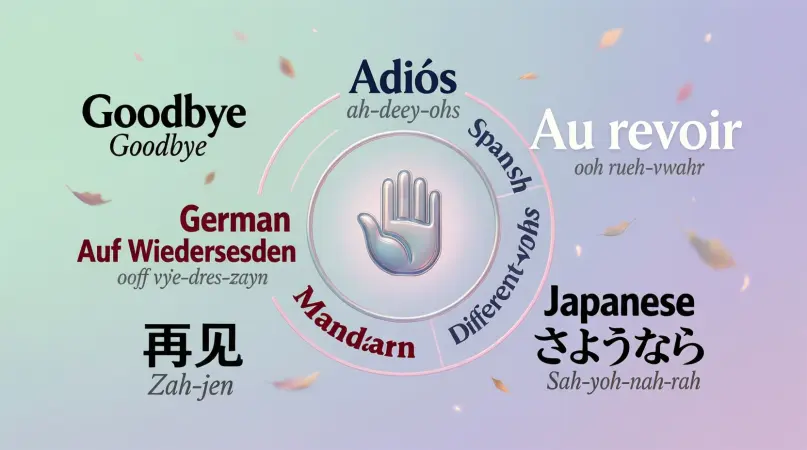
Word: Au revoir
Pronunciation: oh ruh-vwar
Uses: Formal and polite goodbye
Example: Au revoir, merci beaucoup.
Au revoir, à bientôt.
Spain
Word: Adiós
Pronunciation: ah-dee-os
Uses: Common goodbye
Example: Adiós, nos vemos mañana.
Adiós, cuídate.
Germany
Word: Auf Wiedersehen
Pronunciation: owf vee-der-zayn
Uses: Formal goodbye
Example: Auf Wiedersehen, danke.
Auf Wiedersehen, bis bald.
Italy
Word: Arrivederci
Pronunciation: ah-ree-veh-der-chee
Uses: Polite goodbye
Example: Arrivederci, a domani.
Arrivederci, grazie.
Portugal
Word: Adeus
Pronunciation: ah-deh-oos
Uses: Formal or final goodbye
Example: Adeus, boa sorte.
Adeus, até logo.
Brazil
Word: Tchau
Pronunciation: chow
Uses: Informal goodbye
Example: Tchau, amigo.
Tchau, até amanhã.
Netherlands
Word: Tot ziens
Pronunciation: tot zeens
Uses: Polite farewell
Example: Tot ziens, bedankt.
Tot ziens, morgen.
Sweden
Word: Hej då
Pronunciation: hey doh
Uses: Common goodbye
Example: Hej då, vi ses.
Hej då, ha det bra.
Norway
Word: Ha det
Pronunciation: hah det
Uses: Casual goodbye
Example: Ha det, vi snakkes.
Ha det, kos deg.
Denmark
Word: Farvel
Pronunciation: far-vel
Uses: Formal goodbye
Example: Farvel, og tak.
Farvel, vi ses.
Finland
Word: Näkemiin
Pronunciation: nah-keh-mean
Uses: Polite goodbye
Example: Näkemiin, kiitos.
Näkemiin, huomenna.
Poland
Word: Do widzenia
Pronunciation: doh veed-zen-ya
Uses: Formal farewell
Example: Do widzenia, dziękuję.
Do widzenia, do jutra.
Czech Republic
Word: Na shledanou
Pronunciation: nah skhleh-dah-noh
Uses: Formal goodbye
Example: Na shledanou, děkuji.
Na shledanou, brzy.
Russia
Word: Do svidaniya
Pronunciation: doh svee-dah-nee-ya
Uses: Polite goodbye
Example: Do svidaniya, spasibo.
Do svidaniya, do zavtra.
Ukraine
Word: Do pobachennya
Pronunciation: doh poh-bah-chen-ya
Uses: Formal farewell
Example: Do pobachennya, dyakuyu.
Do pobachennya, skoró.
Turkey
Word: Hoşça kal
Pronunciation: hosh-cha kal
Uses: Said when leaving
Example: Hoşça kal, görüşürüz.
Hoşça kal, kendine iyi bak.
Greece
Word: Antío
Pronunciation: an-tee-oh
Uses: Common goodbye
Example: Antío, file mou.
Antío, ta leme.
Israel
Word: Lehitraot
Pronunciation: leh-hit-ra-ot
Uses: See you later
Example: Lehitraot, haver.
Lehitraot, besoon.
Saudi Arabia
Word: Ma’a salama
Pronunciation: ma-ah sah-la-ma
Uses: Polite farewell
Example: Ma’a salama, shukran.
Ma’a salama, ila al-liqaa.
Egypt
Word: Ma’a salama
Pronunciation: ma-ah sah-la-ma
Uses: Standard goodbye
Example: Ma’a salama, ya sadiqi.
Ma’a salama, bukra.
Pakistan
Word: Khuda hafiz
Pronunciation: khoo-da ha-fiz
Uses: Respectful goodbye
Example: Khuda hafiz, Allah hafiz.
Khuda hafiz, phir milenge.
India
Word: Alvida
Pronunciation: al-vee-da
Uses: Formal goodbye
Example: Alvida, dost.
Alvida, phir milenge.
Bangladesh
Word: Biday
Pronunciation: bee-die
Uses: Formal farewell
Example: Biday, bondhu.
Biday, abar dekha hobe.
Sri Lanka
Word: Ayubowan
Pronunciation: ah-yoo-bo-wan
Uses: Polite farewell
Example: Ayubowan, hamuwemu.
Ayubowan, suba dawasak.
China
Word: Zaijian
Pronunciation: zye-jen
Uses: Common goodbye
Example: Zaijian, pengyou.
Zaijian, ming tian jian.
Japan
Word: Sayonara
Pronunciation: sah-yo-nah-rah
Uses: Formal or final goodbye
Example: Sayonara, tomodachi.
Sayonara, mata ne.
South Korea
Word: Annyeong
Pronunciation: ahn-nyong
Uses: Casual goodbye
Example: Annyeong, jal ga.
Annyeong, na jung-e.
Thailand
Word: La gòn
Pronunciation: lah-gawn
Uses: Informal goodbye
Example: La gòn, jer gan.
La gòn, chok dee.
Vietnam
Word: Tạm biệt
Pronunciation: tam beet
Uses: Formal goodbye
Example: Tạm biệt, bạn tôi.
Tạm biệt, hẹn gặp lại.
Indonesia
Word: Selamat tinggal
Pronunciation: seh-lah-mat ting-gal
Uses: Polite farewell
Example: Selamat tinggal, teman.
Selamat tinggal, sampai jumpa.
Philippines
Word: Paalam
Pronunciation: pah-ah-lam
Uses: Respectful goodbye
Example: Paalam, kaibigan.
Paalam, ingat ka.
Malaysia
Word: Selamat tinggal
Pronunciation: seh-lah-mat ting-gal
Uses: Formal goodbye
Example: Selamat tinggal, sahabat.
Selamat tinggal, jumpa lagi.
Australia
Word: Goodbye
Pronunciation: gud-bye
Uses: General farewell
Example: Goodbye, mate.
Goodbye, see you later.
New Zealand
Word: Haere rā
Pronunciation: hi-reh rah
Uses: Traditional farewell
Example: Haere rā, hoa.
Haere rā, kia pai.
Canada
Word: Goodbye
Pronunciation: gud-bye
Uses: Common farewell
Example: Goodbye, take care.
Goodbye, talk soon.
Mexico
Word: Adiós
Pronunciation: ah-dee-os
Uses: Common goodbye
Example: Adiós, amigo.
Adiós, hasta luego.
Argentina
Word: Chau
Pronunciation: chow
Uses: Informal goodbye
Example: Chau, nos vemos.
Chau, cuidate.
Chile
Word: Chao
Pronunciation: chow
Uses: Casual farewell
Example: Chao, amigo.
Chao, hasta mañana.
Colombia
Word: Adiós
Pronunciation: ah-dee-os
Uses: Standard goodbye
Example: Adiós, nos hablamos.
Adiós, cuídate.
Peru
Word: Adiós
Pronunciation: ah-dee-os
Uses: Polite goodbye
Example: Adiós, muchas gracias.
Adiós, pronto.
Venezuela
Word: Chao
Pronunciation: chow
Uses: Informal goodbye
Example: Chao, amigo.
Chao, nos vemos.
South Africa
Word: Goodbye
Pronunciation: gud-bye
Uses: General farewell
Example: Goodbye, my friend.
Goodbye, see you soon.
Nigeria
Word: Odabo
Pronunciation: oh-dah-boh
Uses: Yoruba farewell
Example: Odabo, ore mi.
Odabo, ma a ri e.
Ghana
Word: Nante yie
Pronunciation: nan-teh yee-eh
Uses: Polite goodbye
Example: Nante yie, adamfo.
Nante yie, bio.
Kenya
Word: Kwaheri
Pronunciation: kwa-heh-ree
Uses: Swahili goodbye
Example: Kwaheri, rafiki.
Kwaheri, tutaonana.
Tanzania
Word: Kwaheri
Pronunciation: kwa-heh-ree
Uses: Standard farewell
Example: Kwaheri, asante.
Kwaheri, kesho.
Ethiopia
Word: Dehna hun
Pronunciation: deh-na hoon
Uses: Polite goodbye
Example: Dehna hun, wedaj.
Dehna hun, enehun.
Morocco
Word: Bslama
Pronunciation: bis-lah-ma
Uses: Casual goodbye
Example: Bslama, sadiqi.
Bslama, nshofk.
Algeria
Word: Ma’a salama
Pronunciation: ma-ah sah-la-ma
Uses: Respectful farewell
Example: Ma’a salama, akhi.
Ma’a salama, ila liqaa.
Tunisia
Word: Bslama
Pronunciation: bis-lah-ma
Uses: Informal goodbye
Example: Bslama, sahbi.
Bslama, nchoufou.
Iran
Word: Khodahafez
Pronunciation: kho-da-ha-fez
Uses: Polite farewell
Example: Khodahafez, dustam.
Khodahafez, ta bad.
Afghanistan
Word: Khuda hafiz
Pronunciation: khoo-da ha-fiz
Uses: Respectful goodbye
Example: Khuda hafiz, dost.
Khuda hafiz, baad.
Nepal
Word: Bida
Pronunciation: bee-da
Uses: Formal goodbye
Example: Bida, sathi.
Bida, feri bhetaula.
Myanmar
Word: Thwa dau me
Pronunciation: thwa dow meh
Uses: Leaving goodbye
Example: Thwa dau me, chin.
Thwa dau me, ma lal.
Cambodia
Word: Lea heuy
Pronunciation: lay hoy
Uses: Casual farewell
Example: Lea heuy, mitt.
Lea heuy, chhnam.
Laos
Word: La kon
Pronunciation: lah gawn
Uses: Informal goodbye
Example: La kon, mit.
La kon, phop kan mai.
Mongolia
Word: Bayartai
Pronunciation: bye-ar-tie
Uses: Polite goodbye
Example: Bayartai, naiz.
Bayartai, dahin uulzya.
Kazakhstan
Word: Sau bol
Pronunciation: sow bol
Uses: Common farewell
Example: Sau bol, dos.
Sau bol, kezdesemiz.
Uzbekistan
Word: Xayr
Pronunciation: khair
Uses: Simple goodbye
Example: Xayr, do‘st.
Xayr, tez ko‘rishamiz.
Conclusion
Saying goodbye in different languages helps us understand and respect other cultures. A simple farewell can build connection, kindness, and global understanding.